Selected computational mathematics and quantitative finance projects.
ETH Zürich - Advanced ML - May 2026
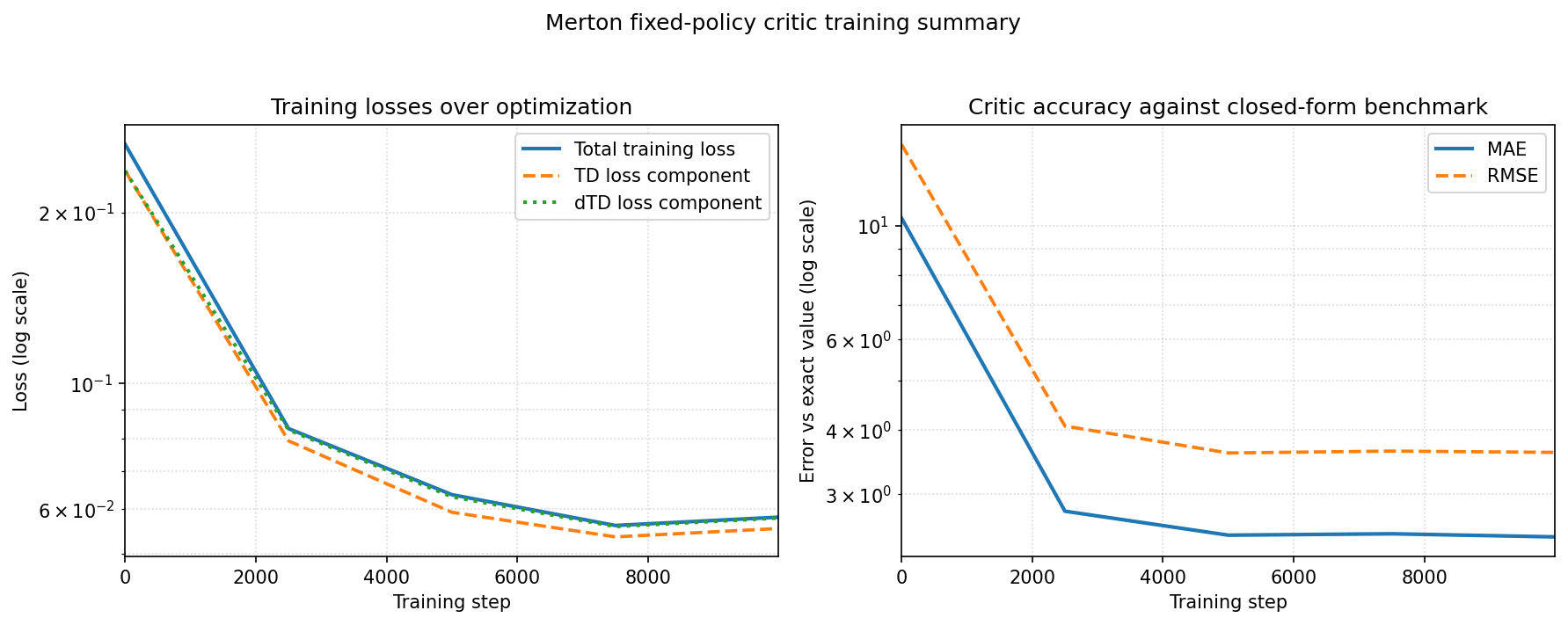
Merton-ctrl: Temporal-Difference Methods for the Merton Problem
A collaborative implementation of the continuous-time Merton consumption-investment problem, comparing TD, differential TD (dTD), and beta-dTD value critics against the closed-form solution.
MATH 478 - Computational Methods for Applied Mathematics - APR 2025
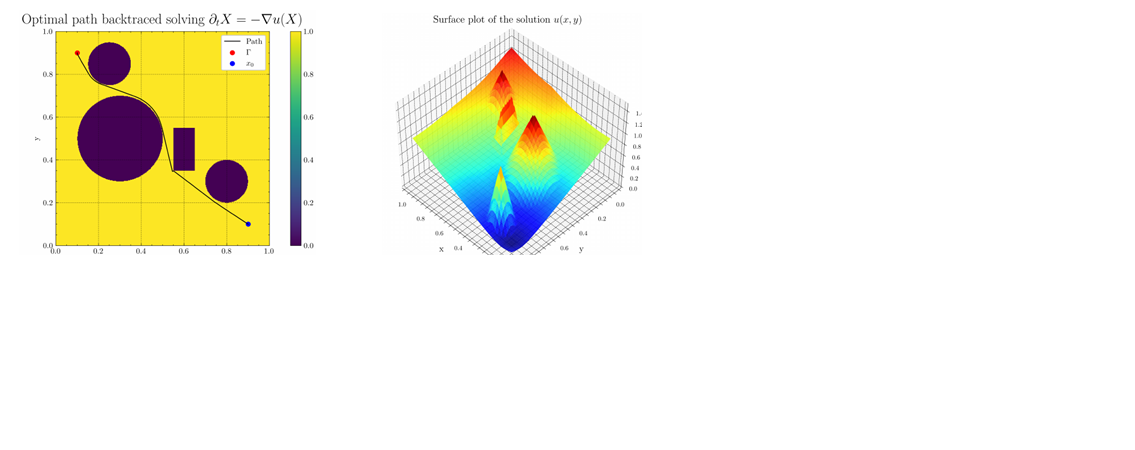
The Fast-Sweeping Method for Eikonal Equations and an Application to Optimal Control
This project studies numerical methods for two-dimensional Eikonal equations and uses the resulting value functions for optimal path planning. The fast-sweeping method is implemented in Python and tested on distance functions, variable-speed media, light refraction through Snell's law, and obstacle-avoidance examples.
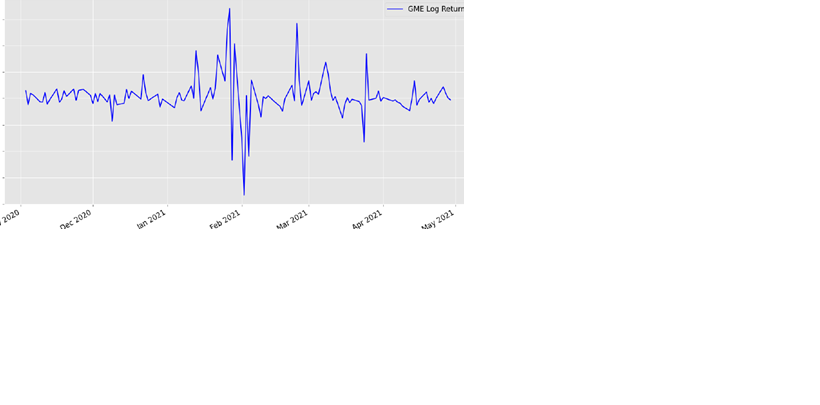
Analysis of Financial Data: Investigation of GARCH(1,1) Models on the Dow Jones Index and Extreme Value Results
This project investigates the tail behavior and extreme value properties of GARCH(1,1) models, with a focus on financial return series where volatility clusters over time and extreme events dominate risk. The work combines theoretical tail-index calculations with numerical experiments and an application to Dow Jones daily log-returns.
The main numerical task is computing the tail index \(\kappa\), including through the fixed-point equation
$$\mathbb{E}\left[(\alpha_1 Z_t^2+\beta_1)^{\kappa/2}\right]=1,$$
and comparing these estimates with the Block Maxima method from Extreme Value Theory.